
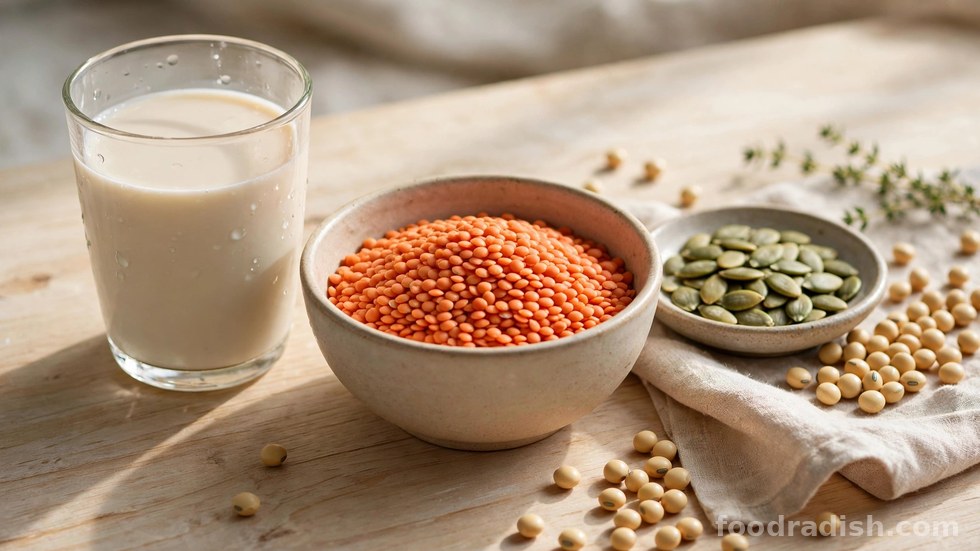
You hit your protein target every day. You eat lentils, tofu, and quinoa on rotation. Yet your strength gains have stalled and your muscles feel flat. The problem might not be how much protein you eat — but whether you are getting enough leucine.
Leucine is the amino acid that flips the switch on muscle building, and plant-based diets are often low in it. In this guide you will learn what leucine does, how much you need, the best vegetarian leucine sources ranked by content, how to structure meals around the leucine threshold, and answers to the most common questions.
Table of Contents
- What Is Leucine & Why Does It Matter?
- How Much Leucine Do You Need?
- Best Vegetarian Leucine Sources (Ranked)
- The Leucine Threshold: Structuring Your Meals
- 3 Leucine Myths, Busted
- Sample High-Leucine Day of Eating
- Frequently Asked Questions
What Is Leucine & Why Does It Matter?
Leucine is one of three branched-chain amino acids (BCAAs) and the only one that directly activates mTOR — the cellular pathway that triggers muscle protein synthesis. Think of protein as the building materials and leucine as the foreman who tells the crew to start building. Without enough leucine, the materials sit unused.
This matters more for vegetarians because plant proteins are generally lower in leucine than animal proteins. Whey protein is about 11% leucine; most legumes sit at 6–8%. You can absolutely get enough from plants — but it requires intention, not accident.
The research is clear: meals that deliver sufficient leucine stimulate measurably more muscle building than equal-protein meals that fall short. For vegetarians focused on strength, this single amino acid may be the highest-leverage nutrition detail you are ignoring. If muscle building is your goal, our guide on building muscle on a vegetarian diet covers the full science.
How Much Leucine Do You Need?
Research points to a leucine threshold of roughly 2–3 grams per meal to maximally trigger muscle protein synthesis in adults. Older adults may need the higher end (3g+) because aging muscles respond less sensitively.
What does 2.5 grams of leucine look like in food?
- 150g firm tofu: ~2.5g leucine
- 1.5 cups cooked lentils: ~2.2g leucine
- 1 cup edamame: ~2.0g leucine
- 1 cup Greek yogurt: ~2.5g leucine
- 30g soy protein isolate: ~2.7g leucine
Notice the pattern: it takes meaningful portions of plant proteins to cross the threshold. A sprinkle of chickpeas on a salad will not do it — but a proper legume-centered meal will.
Best Vegetarian Leucine Sources (Ranked)
Leucine content per typical serving, best first:
- Soy protein isolate: ~2.7g per 30g scoop — the plant leucine champion
- Tempeh: ~2.2g per 150g serving — fermented, digestible, versatile
- Firm tofu: ~2.5g per 200g serving
- Lentils: ~2.2g per 1.5 cups cooked
- Greek yogurt: ~2.5g per cup — the best dairy option
- Edamame: ~2.0g per cup
- Chickpeas: ~1.5g per 1.5 cups — good, but needs a boost
- Quinoa: ~1.0g per 1.5 cups — better as a complement than a lead
- Pumpkin seeds: ~1.0g per 30g — excellent as a meal topper
The practical takeaway: lead with soy or lentils at your main meals, and use grains, seeds, and vegetables as supporting players. Comparing protein sources head-to-head? Our plant protein powder comparison breaks down which powders deliver the most leucine per scoop.
The Leucine Threshold: Structuring Your Meals
Anchor Every Meal
Build each of your three main meals around one leucine-rich anchor: tofu or tempeh at lunch, lentils at dinner, Greek yogurt at breakfast. This alone gets most people over the threshold three times daily.
Combine Strategically
Pair a moderate-leucine food with a booster. Chickpea curry (1.5g) plus a hemp-seed topping (0.7g) plus a side of quinoa (0.5g) crosses 2.5g comfortably. Our article on combining proteins explains the broader amino-acid pairing strategy.
Do Not Forget Breakfast
Breakfast is the most leucine-deficient meal in most vegetarian diets — toast, fruit, and coffee deliver almost none. A tofu scramble, Greek yogurt bowl, or soy-milk smoothie fixes it in one move.
3 Leucine Myths, Busted
- “You need BCAA supplements.” Whole foods deliver leucine alongside all other amino acids your body needs. Isolated BCAAs without the rest are like hiring a foreman with no crew.
- “Only animal protein has enough leucine.” False. Soy, lentils, and dairy match or approach animal sources per meal-sized serving.
- “More leucine is always better.” The threshold effect plateaus — once mTOR is activated, extra leucine in the same meal adds little. Spread it across meals instead.
Sample High-Leucine Day of Eating
Theory is useful, but here is what a leucine-optimized day actually looks like for a vegetarian eating around 110 grams of protein:
- Breakfast (2.6g leucine): Greek yogurt (1 cup) with hemp seeds, walnuts, and berries. Fast, no cooking, and it clears the threshold before 9 a.m.
- Lunch (2.8g leucine): Tempeh grain bowl — 150g marinated tempeh over quinoa with roasted vegetables and tahini dressing. Meal-prep friendly and deeply satisfying.
- Pre-workout snack (1.2g leucine): A banana with 2 tablespoons of peanut butter. Not a full threshold dose, but it tops up amino acids ahead of training.
- Dinner (2.5g leucine): Red lentil dal (1.5 cups) with brown rice and a side of sautéed spinach with garlic. Comfort food that quietly delivers.
Total: roughly 9 grams of leucine across the day, with three solid threshold-crossing meals. Notice that nothing here is exotic or expensive — just deliberate portions of familiar foods. That is the whole secret: leucine optimization is about portion awareness, not special products.
Frequently Asked Questions
What is the best vegetarian source of leucine?
Soy protein isolate tops the list (~2.7g per 30g), followed by tempeh, firm tofu, and lentils in meal-sized portions.
Can I get enough leucine without supplements?
Yes. Three meals anchored by tofu, tempeh, lentils, or Greek yogurt reliably deliver 2–3g of leucine each — no supplements required.
Does leucine help with weight loss?
Indirectly. By preserving muscle during a calorie deficit, adequate leucine keeps your metabolism higher and improves body composition as you lose fat.
Is leucine safe in normal food amounts?
Completely. Leucine from whole foods has no safety concerns; it is simply an amino acid your body uses every day.